
Designing Welded Structures:
What Engineers Should Consider Before Fabrication
Design for manufacturing, early input is essential
When engineers design structural components that will be fabricated and welded, many of the most important manufacturing decisions are made long before production begins. Drawings may appear straightforward on screen, but the physical process of cutting, forming, welding and machining a structure introduces constraints that must be considered during the design stage. If these factors are not addressed early, the structure may become difficult to fabricate, more expensive to manufacture, or prone to dimensional issues during assembly. Understanding how fabrication processes interact with structural design allows engineers to create welded assemblies that are both efficient to manufacture and capable of meeting the required structural performance.
Material selection
The material chosen for a welded structure influences both manufacturing behaviour and final performance. Structural steels, high‑strength steels and aluminium alloys all respond differently during welding. Material thickness also plays a role in fabrication planning. Thicker materials require greater welding heat input, which can increase the likelihood of distortion. High‑strength materials may require controlled welding procedures to maintain mechanical properties after welding. Selecting materials that are appropriate for the intended welding process and structural requirements is therefore an important step during the design stage.
Weld access
One of the most common issues encountered during fabrication occurs when welds are difficult to access. Engineers may design joints that appear simple in a CAD model but cannot be easily reached by a welder or welding torch. When weld access is restricted, manufacturers may need to change welding sequences, modify joint preparation or introduce additional fabrication steps. Considering weld access during design helps ensure joints can be welded efficiently while maintaining consistent weld quality.
Distortion risk
Welding introduces heat into the material which causes local expansion and contraction as the weld cools. This process can cause fabricated structures to move slightly during manufacturing. The location and sequence of welds can significantly influence how a structure behaves during welding. Long weld runs or welds concentrated in one area can introduce residual stresses that lead to distortion. Engineers often reduce distortion risk by designing symmetrical weld layouts, distributing welds across the structure or allowing machining operations to restore critical dimensions after fabrication.
Machining allowances
Many fabricated assemblies include machined features such as mounting interfaces, sealing surfaces or alignment features. These surfaces must meet tight dimensional tolerances to ensure correct assembly. Because welding can introduce slight movement within a structure, manufacturers often machine critical interfaces after fabrication. This approach ensures final dimensions are achieved even if minor distortion occurs during welding. Designing components with appropriate machining allowances allows manufacturers to perform these finishing operations efficiently.
Fixturing Considerations
During fabrication, components are often held in dedicated fixtures or jigs that maintain alignment while welding takes place. These fixtures ensure that structural parts remain positioned correctly as welds are applied. Designing parts that can be located and clamped easily within fixtures simplifies manufacturing and improves repeatability. Complex geometries that cannot be securely held during welding may introduce additional manufacturing challenges.
Inspection and Tolerance Strategy
Not every dimension in a fabricated structure requires the same tolerance. Engineers must decide which dimensions are critical for function and which can allow greater variation. By defining tolerance strategy carefully, designers can ensure critical features receive appropriate machining or inspection while avoiding unnecessary manufacturing complexity.
Integrating Design and Manufacturing
The most successful fabricated structures are designed with manufacturing processes in mind. When engineers understand how welding, fabrication and machining interact, they can create designs that minimise production risk while maintaining structural performance. Manufacturers capable of combining fabrication, welding and precision machining within the same facility are often able to support this process more effectively because they can manage distortion, machining allowances and assembly alignment within a single production environment.
The reason distortion happens is rooted in heat. Welding introduces local heat into the material, causing it to expand in the weld area. As the weld cools, that same area contracts. If this cycle happens unevenly across the assembly, the structure can pull, twist or bend. In thin sections, this can happen quickly. In heavier armoured structures, the same principle applies, but with higher heat input, thicker materials and greater structural consequences.
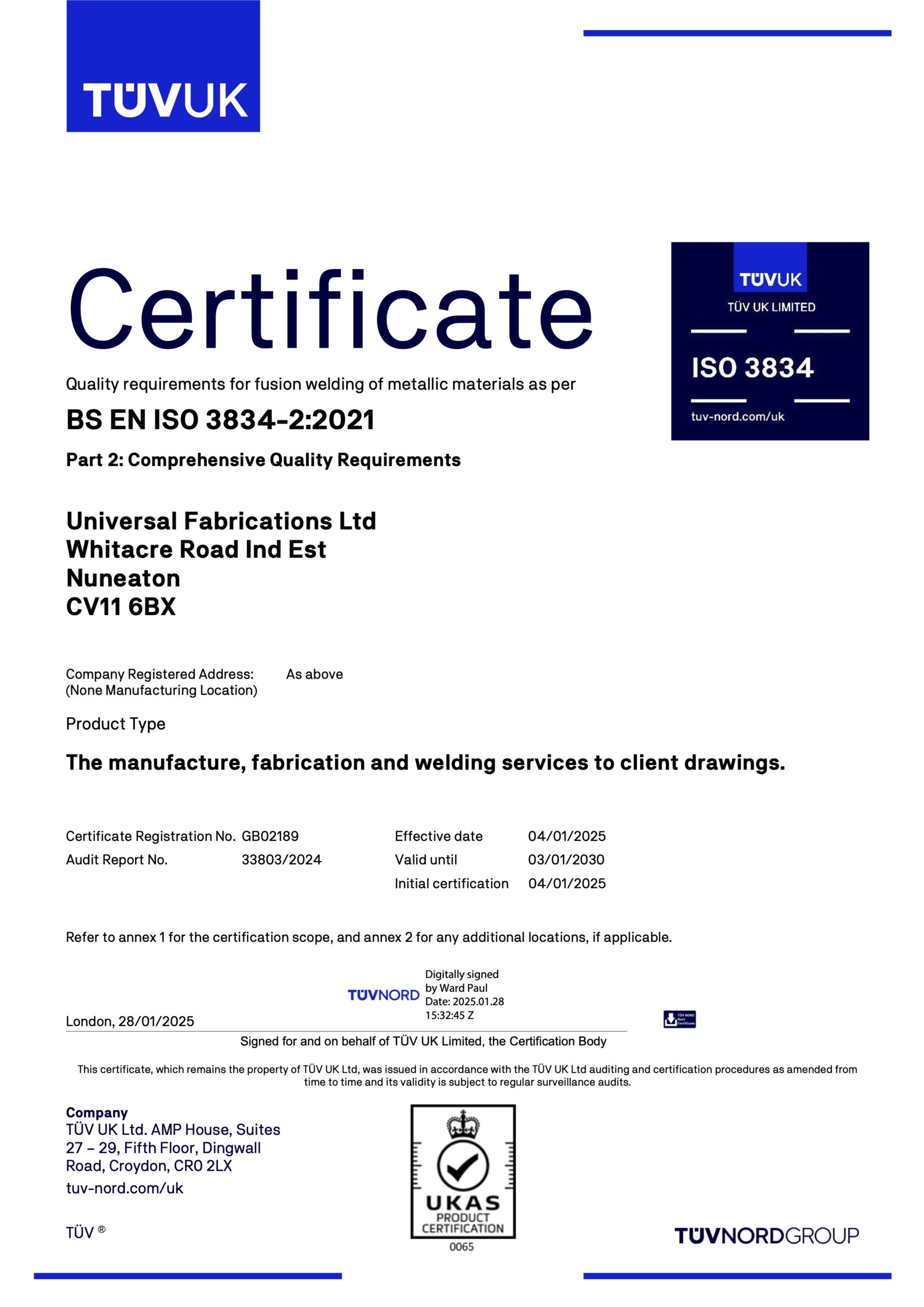
Companies producing complex fabricated assemblies often combine fabrication, welding and machining processes to achieve both structural integrity and dimensional accuracy. Universal Fabrications supports this through integrated metal fabrication, coded welding and precision machining capabilities. Engineers designing structural weldments can also benefit from early design‑for‑manufacture input to ensure components transition efficiently from prototype development into production manufacturing.
Frequently Asked Questions
Why must welded structures be designed differently from machined parts?
Welded structures behave differently during manufacturing because welding introduces heat that can cause expansion and contraction. Designs must account for this movement.
Why is weld access important in structural design?
Poor weld access can make joints difficult to manufacture and may reduce weld quality if the welding torch cannot reach the joint correctly.
Why are machined features often added after fabrication?
Machining critical surfaces after welding ensures that features such as mounting faces or sealing interfaces meet precise tolerances.
How can engineers reduce distortion in welded structures?
Distortion can be reduced by planning weld locations carefully, distributing welds across the structure and using fixtures to control alignment during welding.
What role does fixturing play in fabrication?
Fixtures hold components in the correct position during welding, helping maintain dimensional accuracy and repeatability.
Related Articles
Case Studies
Related Services
Speak to a Manufacturing Specialist today. Call 02476 370 272 or send us an email.
Speak to a manufacturing specialist.
Call us today on 02476 370 272 or email us at email@universalfabrications.com