
Welding Standards Used in Defence Manufacturing
Importance of Welding in Defence Fabrication
Welding is one of the most important manufacturing processes in defence fabrication. Structural components within military vehicles, support systems and associated equipment often depend on welded joints for load transfer, rigidity and long-term durability. In that environment, the weld is not just a joining method. It becomes part of the structural performance of the finished product. That is why customers in defence and other high-consequence sectors place so much weight on welding standards and procedure control.
What ‘coded welding’ actually means
When people talk about welding standards, they often reduce the topic to a simple phrase such as ‘coded welding’. In practice, the subject is broader than that. Standards govern different parts of the welding system: the qualification of the welder, the qualification of the procedure, the control of the manufacturing environment and the wider quality framework within which the welding takes place. Together, these controls help ensure the final weld is not reliant on chance or individual flair. It is produced through a process that can be repeated and verified.
Why defence assemblies require repeatable welding processes
For structural defence work, this matters because fabrication assemblies often experience significant operational loads, vibration and environmental exposure. A visually acceptable weld is not always enough. Customers need confidence that the procedure used is appropriate for the material, thickness and joint configuration, and that the people carrying out the work are qualified to do so. This is where recognised standards become important. They create a common framework for assessing capability and controlling quality.
Universal Fabrications, military welding experts
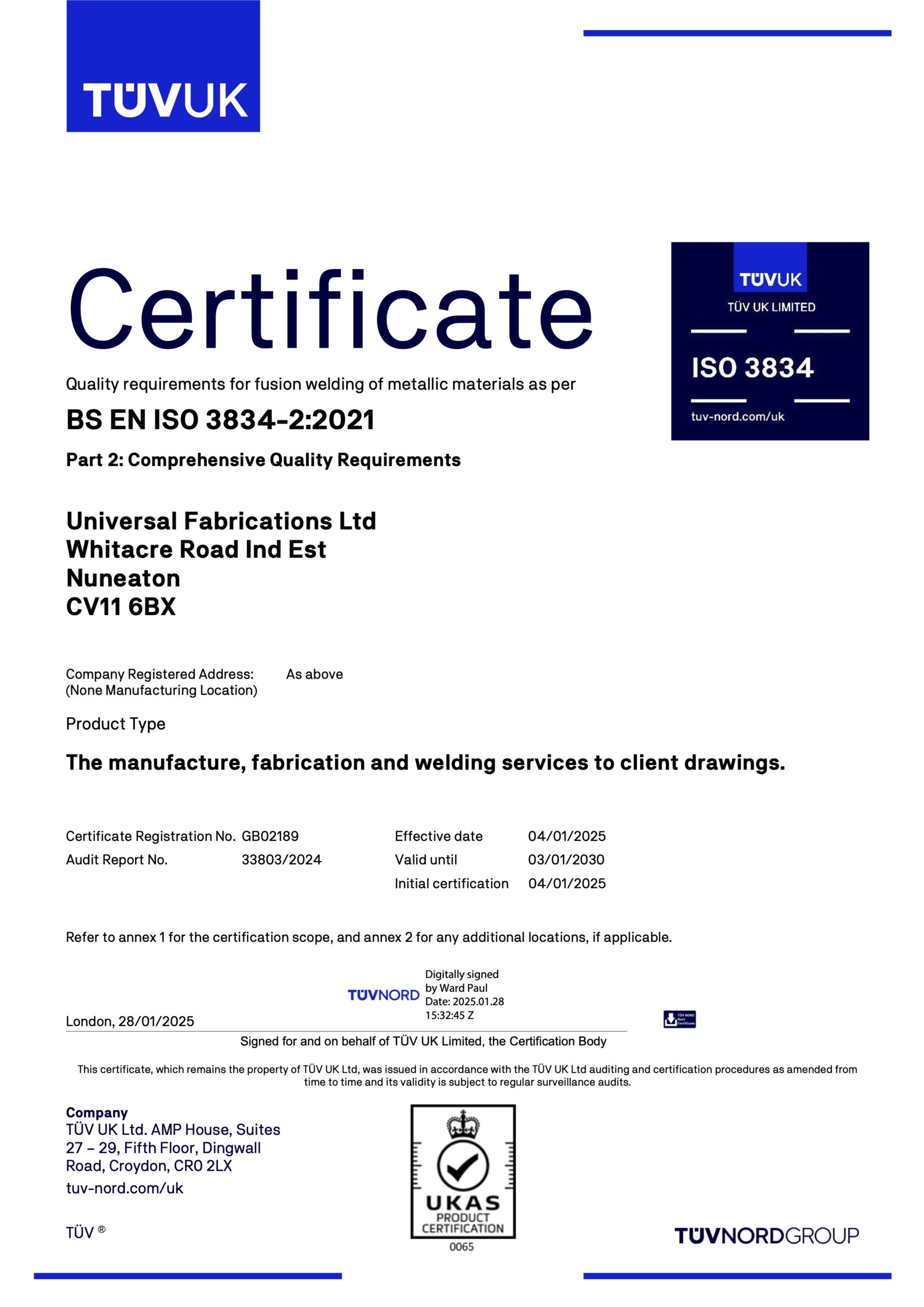
Universal Fabrications has been welding for the defence industry for over 20 years. Sitting within their ISO 9001 quality accreditation is their welding accreditations and standards. These include BS EN ISO 3834-2, BS EN ISO 15613, BS EN ISO 9606-1, BS EN ISO 9606-2 and AWS D17.1. The standards are not mere quality badges they indicate a controlled welding environment rather than an informal workshop process which is critical to structural welding success.
Choosing the right welding process for defence applications
Another important consideration is that not every structural job should be welded in the same way. Material type, section thickness, access, cosmetic requirements, productivity needs and distortion risk all influence process choice. A supplier that can use multiple welding methods is often better positioned than one that relies on a single preferred process. Universal’s wider site content references MIG, TIG, robotic and laser welding, which is useful because it reflects practical flexibility rather than a one-size-fits-all approach.
How welding affects machining, fit and dimensional stability
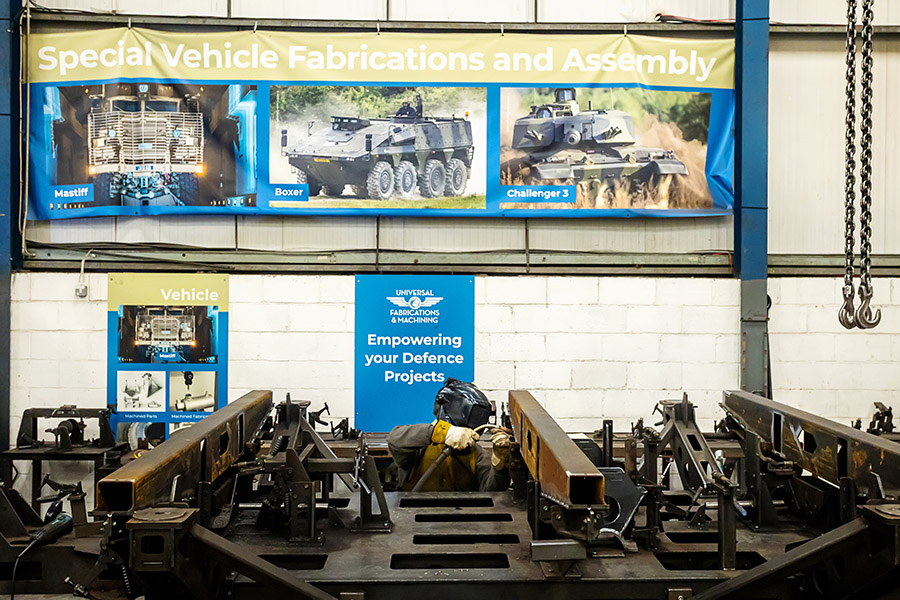
Defence customers also care about how welding interacts with the rest of the manufacturing process. This is one of the reasons welding capability cannot be viewed in isolation. Distortion created during welding can affect machining tolerance, assembly fit and overall part stability. Fixtures and jigs may be needed to hold the structure correctly. Sequence planning may be required to manage heat movement. Inspection may need to confirm not only the weld appearance, but also the dimensional condition after welding. In real manufacturing, these interactions are often more important than the abstract standard itself.
Why integrated fabrication and machining capability matters
That broader process view is where a business with integrated fabrication and machining capability can be particularly valuable. If a supplier understands how a welded assembly later moves into machining or into a vehicle build, then welding decisions are more likely to support the result rather than create downstream problems. In this sense, standards are part of the answer, but not the whole answer. The whole answer is a disciplined manufacturing system where the standards are used within a practical understanding of the finished part.
What defence buyers should look for in a welding supplier
For buyers and engineers evaluating suppliers, this is the real reason welding standards matter. They provide visible evidence of control, but they also signal something deeper: that the supplier takes structural manufacturing seriously, understands traceability and repeatability, and is operating in a way that supports reliable delivery rather than unpredictable workshop outcomes.
In defence manufacturing, that combination of standards, process awareness and practical experience is what turns welding from a generic capability statement into a credible part of a supplier’s offer.
Frequently Asked Questions
What is coded welding?
It generally refers to welding carried out by qualified welders working to recognised procedures and standards relevant to the application.
Why are welding standards important in defence work?
Because defence assemblies often rely on welds for structural performance, and customers need confidence that those welds are produced through controlled, repeatable methods.
Does one welding standard cover everything?
No. Different standards apply to welder qualification, procedure qualification, quality management and wider process control.
Why does the welding process choice matter?
Different materials, thicknesses, production volumes and distortion risks may call for different welding methods such as MIG, TIG, robotic or laser welding.
Related Articles
Case Studies
Related Services
Speak to a Manufacturing Specialist today. Call 02476 370 272 or send us an email.
Speak to a manufacturing specialist.
Call us today on 02476 370 272 or email us at email@universalfabrications.com