
How Armoured Vehicle Structures Are Manufactured
Why armoured vehicle structures require specialist fabrication
Armoured vehicle structures are rarely simple fabrications. They are engineered assemblies designed to deliver strength, protection and durability while also integrating accurately with surrounding systems such as suspension mounts, brackets, driveline interfaces, enclosures and protective structures. That combination of structural performance and dimensional control is what makes armoured vehicle fabrication a specialist area of manufacturing rather than a straightforward heavy welding exercise.
Material selection and performance in armoured structures
The process starts with the material. Military vehicle structures often make use of high-strength steels or armour-grade materials that behave differently from standard fabrication steel. These materials can be more demanding to cut, form and weld, and they often require careful control of heat input to avoid compromising structural performance. In practical terms, that means fabrication planning has to begin with a sound understanding of the chosen material, the section thickness and how the structure is expected to perform once assembled into the wider vehicle.
Cutting and forming: building accuracy from the first stage
Once the material is selected, plate sections are cut and formed to match the required geometry. At this stage, consistency matters because small deviations introduced early can create larger problems later in the build. Features such as folded sections, stiffeners, mounting faces and structural joins all need to be considered not only as individual parts, but as part of the final assembled structure. This is one reason design-for-manufacture input is valuable at the front end of a project. It helps identify where a structure can be simplified, how the weldment should be sequenced and where later machining may be needed.
Welding challenges in armoured vehicle fabrication
Welding is the stage where the most obvious structural assembly happens, but it is also the stage where many of the biggest manufacturing risks appear. Heat introduced during welding causes local expansion and contraction within the material. If that thermal movement is not controlled, the structure may distort, twist or pull out of alignment. In armoured vehicle fabrication, where multiple thick sections and intersecting welds are common, this becomes a serious challenge. Distortion can affect fit, introduce rework and reduce the ability of the assembly to meet downstream machining or installation requirements.
Managing distortion through fixtures and weld sequencing
To manage this, experienced manufacturers use a combination of fabrication fixtures, welding jigs and planned weld sequencing. Fixtures help hold parts in position while the weld is applied. Sequencing helps distribute heat more evenly across the assembly so movement does not accumulate in one direction. This is where practical fabrication experience makes a difference. Many structural problems are not visible on a drawing, but they become obvious when the part is built repeatedly in the real world.
Where fabrication meets machining: achieving critical tolerances
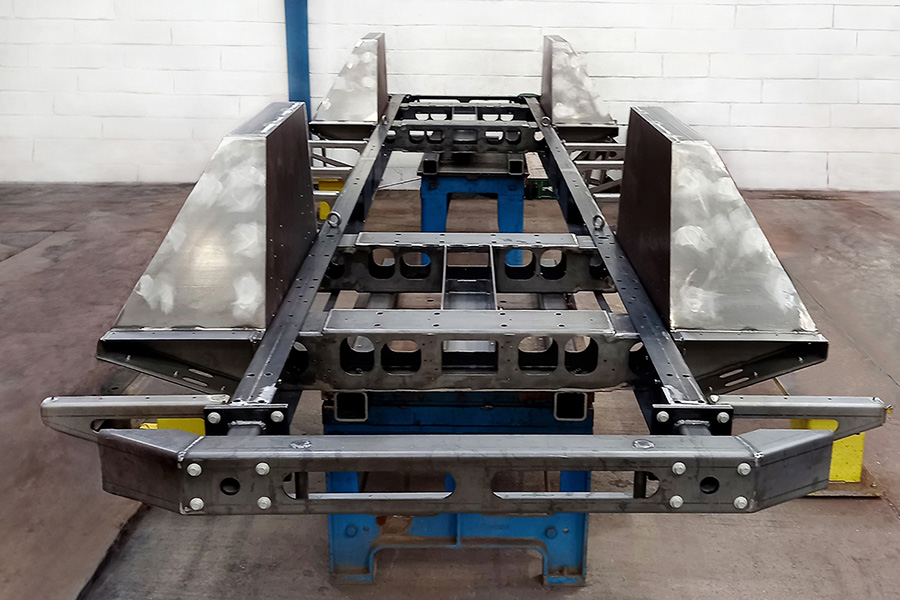
Another important point is that armoured vehicle structures are often hybrid parts. They may be fabricated as weldments, but they frequently include machined features that need to achieve tighter tolerances than fabrication alone can hold. Mounting faces, alignment features, hole positions and interface surfaces are all common examples. This is why the combination of fabrication and machining is so important in defence manufacturing. The structure may be built through welding, but the final accuracy of critical areas often depends on machining carried out afterwards.
Integrated fabrication and machining in defence manufacturing
Universal Fabrications’ own defence positioning aligns strongly with this type of work. The company combines sheet metal fabrication, welding and CNC machining within the same business, which enables structural parts to move through multiple processes without being fragmented across unrelated suppliers. For defence vehicle structures, that integration can make a real difference. It reduces handover risk, supports better control of tolerances and allows the business to take a more complete view of how a part should be manufactured from raw material through to final inspection.
Inspection, quality control and traceability
Inspection and traceability are also a key part of the process. Fabricated military structures do not finish when the welding is complete. They need to be checked for dimensional accuracy, weld quality and conformance to the relevant standards. In sectors such as defence, this is part of supplier credibility. Customers need confidence that the manufacturing process is controlled, repeatable and supported by the right quality systems.
What defines a successful armoured vehicle structure
When all of these elements are combined properly, the result is not simply a welded structure. It is a manufactured assembly that is structurally robust, dimensionally controlled and suitable for integration into a demanding operational environment. That is what armoured vehicle fabrication really involves, and it is why capability in this area depends on much more than the ability to weld thick steel together. can support early-stage discussions to help define the most appropriate manufacturing approach.
Frequently Asked Questions
Why are armoured vehicle structures usually fabricated rather than machined from solid?
Fabrication is generally more efficient for large structural components because it uses plate and formed sections to create the required shape without removing excessive material from billet.
What makes armoured vehicle fabrication more difficult than standard fabrication?
Material grade, plate thickness, distortion risk, structural requirements and the need for repeatable accuracy all increase the difficulty.
Why is machining still needed on fabricated vehicle structures?
Machining is often required for mounting faces, hole positions, sealing interfaces and other critical features where tighter tolerances are needed.
How is distortion controlled during manufacture?
Manufacturers use welding fixtures, jigs, planned weld sequencing and post-weld machining of critical areas to maintain dimensional control.
Related Articles
Case Studies
Related Services
Speak to a Manufacturing Specialist today. Call 02476 370 272 or send us an email.
Speak to a manufacturing specialist.
Call us today on 02476 370 272 or email us at email@universalfabrications.com